
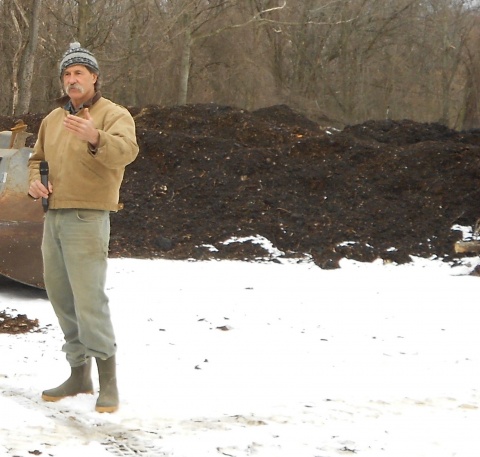
For my first blog post as a “Rot Star In-Residence”, I see nothing more relevant to discuss than my morning activities. The weather was bleak and the rain was falling as I sat in the Milton, VT Park and Ride waiting for Tyler (Highfields’ Outreach Coordinator) and his purple van to retrieve me and travel to Richard Hudak’s farm in St. Albans, VT (Hudak Farm website). Richard Hudak and his family own and operate a farm in St. Albans that yields excellent fruits and veggies that are available for purchase from an amazingly well-crafted farm stand on site (the woodworking is quite a sight to see). Richard also has a composting site on his property that accepts food scraps from schools and local businesses in the St. Albans region as a part of the Close the Loop! program, totaling about 4 or 5 tons of food scraps per week when all schools are in session.
When Tyler and I pulled in, the farm was busy with activity despite the wet weather. Richard’s son gave a friendly wave as he passed by on the tractor, and no more than a minute later we found Richard exiting the farm stand. He smiled as soon as he saw the purple van, and invited both Tyler and I in for a cup of tea.
As soon as we sat down, the topic of conversation changed from catching up to compost. Trommel screeners; new food scrap generators; hauling opportunities; carbon feed stocks; conversation flowed from one subject to another. “Sometimes I feel like I am literally a man made of chocolate,” Richard remarked, as he paused to reflect on handling organic waste from the Ben and Jerry’s factory.
Finally our conversation boiled down to our reasoning for coming: the steel tote-tipper three-point hitch implement prototype that Richard and his son have been constructing for a Close the Loop! pilot project. The tea was still steaming as we got into the meat of our discussion on materials, weight, feasibility to move, and functionality. The tote-tipper is a steel platform with a ramp for rolling totes up, and a tote-bar (like the green one you can see in the picture above) that is meant to prop totes against, allowing for dumping food scraps directly into windrows. The prototype will be used by Terrance LaPointe, composter and owner of Wise Worm Compost. Tea concluded, and we left the shelter of Richard’s house to examine the tipper. It looked great!
I chose this morning to talk about for my first blog post because I wanted to provide insight into the true grassroots, from the ground up, type work that goes into our Close the Loop! programs. We are in an exciting transition period where organic waste is beginning to be widely recognized by citizens, institutions, businesses, and governments as a valuable resource as opposed to waste item that goes to a landfill . To meet the requirements of progressive legislation like Vermont’s Act 148, various scales of composting are necessary, from resident backyard composting to large-scale composters accepting upwards of 48 tons per week of organics. This need for composting programs tailored to meet the needs of specific regions has provided an open canvas for pilot projects and prototypes to be developed or constructed for composting on smaller scales. There is no factory to call and request a tote-tipper platform that is 5 feet by 5 feet and can be attached to a tractor; just Richard and his son in the tractor garage on their farm. It is the efforts of people like Richard and his family, in conjunction with Close the Loop!, that will help the state of Vermont reach complete organics diversion by 2020.