
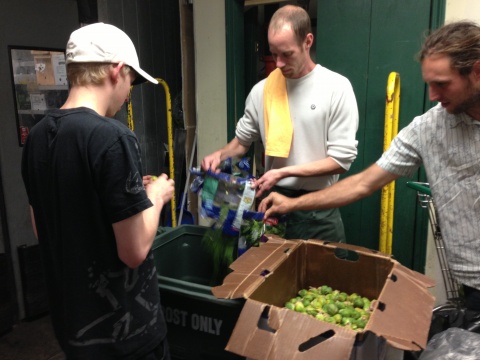
Every time a new FSG (“Food Scrap Generator”) decides to join a Close the Loop! composting program, part of the process involves delivering materials to effectively collect organics (totes, five-gallon buckets, sawdust, composting guides), and training staff to use these materials efficiently. On Wednesday, I was able to get on the road with Tyler Buswell (Highfields’ Outreach Coordinator), and go to St. Johnsbury, VT, to observe how these trainings are conducted.
The two stops for the day were the St. Johnsbury House, a senior living community, and White’s Market, an independently-owned grocery store with three locations in the Northeast Kingdom of Vermont (all of which now compost!).
A major component of these trainings is working with management and staff to ensure that the compost process does not become a burden or create a lot of additional work. The location of totes; the ability to minimize contamination; and finding the right size collection container are just some of the topics brought up during a training that address this issue. Odors and pests are another area of concern that are covered during trainings. To control odors and keep away flies and other pests, each FSG is provided with sawdust to cap a tote that contains organic material.
The trainings that we conducted on Wednesday were a success, and Tyler and I returned to Hardwick feeling confident that both the St. Johnsbury House and White’s Market will do a top-knotch job of diverting their organics. For me, the most memorable part of the day came when Tyler and I were chatting with Eric, the Produce Manager at White’s Market, about the owner’s decision to compost. “Some of the staff were saying how it [composting] was going to mess up their routine…you just have to make it part of the routine.” Couldn’t have said it better myself.